Updated: March 4, 2009; April 30, 2011
Catamarans are double-hulled ships. Usually, they are somewhat small designs, which is why I decided to go for something big. An aircraft carrier roughly the size of USS Nimitz, with one clear distinction - a double hull. I was thinking a lot about the feasibility of this concept and could not find anything wrong. Twin hulls meant better stability on rough seas, better redundancy of all critical systems, higher survivability, and whatnot. So I decided to create one. It's another Google SketchUp thingie, lots of clean, straight lines and basic rendering. So if you've liked the others, you'll this one, and if not ... Anyhow, let's rock ... eh ... float.
Gallery
As always, a nice cozy isometric view to get you comfy with my latest madness. The carrier has two completely identical hulls, connected by gigantic spars, which also double as connection ways between the hulls, allowing people and materials to be shuffled back and forth. The isle is stationed centrally, minimizing the impact on the two V-shaped landing decks.

Looking from above, you can appreciate the grace and beauty of the carrier - and all the classic must-have
elements that modern carriers sport. Notice the six aircraft elevators, all mounted inboard to prevent possible
damage from missile attacks.

From the bow and stern, the carrier strikes a menacing, solid silhouette. The service cranes toward the rear nicely offset the powerful lines of the twin hulls.


From the side (starboard, if you will), the carrier is the classic example of a floating airbase.

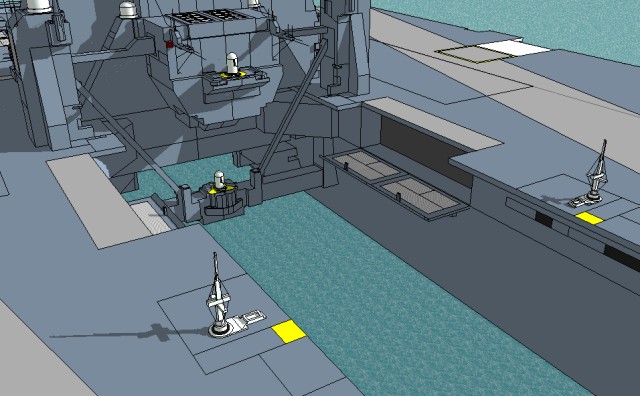
I've paid quite a bit of detail to weaponry. While American carriers carry relatively little weapons, relying on its air wing and the supporting task force of cruisers and destroyers to enforce and impenetrable air defense net, I've made my carrier slightly more Russian and armed with lots of guns and missiles. First, let's take a look at the R2D2-like Vulcan Phalanx-sque CIWS guns, sprinkled about the deck like wild mushrooms. We can see the outboard R2D2 defending the waterline flanks:

Then we have a pair, mounted centrally and facing toward the stern:
A closer look:

There's another pair of guns on the isle, complementing the "low" pair; other domes belong to various radar units. There are more units positioned on the flight deck forward, for a grand total of 12 cute little robots.

I also gave my ship some cruise missiles in vertical launchers, known as VLS, and quad anti-shipping units sporting Harpoon. And there's also a big automatic 127mm dual anti-aircraft anti-shipping gun mounted on fore isle. You must admit the pristine white of the weapon tube hatches and radar domes contrast the dull navy seagull-gray paint scheme in a rather pleasing way.

The big gun:


Airplanes are another important element in this gallery. When I first created the carrier, it was a bit boring, especially due to its unique symmetry. So I imported my Su-35 wannabe model and placed some four units on the landing deck, breaking the boredom. The planes are positioned randomly on the deck and their bright yellow-brown camouflage is a good addition to the dreary palette. Oh, they are another Ruskie element here, being Su-27 lookalikes.


A more intimate look of the elevators supported to service aircraft in and out of the belowdeck hangars.

And a wild shot of the various radar domes. Mushrooms, indeed. But if you take a look at a few real images of combat warships, you'll notice I have not exaggerated that much.

I've also created a few screenshots of the complex flight deck. The actual landing strip is painted gray so that it can be more easily spotted from the air. I believe it's too narrow, but it does not matter really.

Another angle:

And a daring, sharp look of the catapult rails and the jet exhaust deflectors, currently lowered. Notice the two R2D2s framing the TO section.

I've noticed that real carriers have messy, crowded sterns, so I tried to recreate this. I've added the service cranes to make things look busier. I think the overall effect is nice.

Connecting the two hulls is a massive mid-section, almost a third hull, with powerful spars that also counter-act against any bending forces on rough seas, as the two hulls might not be experiencing the exact same strain. I do not know if this could work in reality, but it sounds better than a rigid link.


Lastly, a few screenshots of the isle - or the tower if you will. Lots of wires, lots of activity.


This one is pretty decent, you must agree:

A long shot, with command bridge windows adding life to the model:

And just before we part ways, one last bird's eye view from amidst the many lines of antennae high in the electronic forest on top of the isle.

I guess that's it. I think this is a quite decent 3D model. Hopefully, you've enjoyed it watching as much as I did creating it. Took me some 10 hours, I think - and it's definitely better looking than my first model: DD 71.
Kerkythea images
Time for proper fun ... This is madness, Sparta, uh ... realistic rendering. Here's the same model, only re-created using Kerkythea, after exporting the model using SketchUp Importer for Google SketchUp and rendered with photons and ray tracing and magic and whatnot. You will like this. My dream of making near-realistic models is coming true, finally. Nirvana. Spledidski.
OK, so here's a nice isometric shot. The skin is rendered in between plastic and metal, with a sort of thick mat anti-reflective paint used for military ships. No background yet, but this is just a warmup.

And another one, a little more zoom and a shallow angle:

Now, the real deal, with authentic sea and some extra clouds added in GIMP, so it appears like a photo taken by an overhead scout plane. And yes, that is a real sea, even if it looks like a pimpled teenager's back. The carrier skin is also more bumpy, so it appears like aluminum and steel sheeting beaten with wear. The sea shadows might need a sharper outline, but don't mind that.


A few more rather lovely renders, showing the carrier bathed in early sunrise. The water is calm and gray. If this does not stir a feeling deep in your artistic soul, nothing will. Rendered in about 10 minutes of CPU time with four threads on my HP laptop.
Notice the smooth metallic sheen on the gun turrets and radomes. Notice the slightly grainy feel to the landing deck. I'm really pleased with the output, although yet more quality can be milked from these renders. But that's what sequel articles are for, right.


That's amazing, I have to say. Self-flattery is stupid, but sometimes well deserved. Oh, more good stuff coming, including POV-Ray renders, extra galleries and suchlike. Stay tuned for updates.
Cheers!