Updated: August 5, 2026
A friend of mine sent me a link to a 9gag meme. The link had a preview thumbnail. I have my WhatsApp client set not to show previews, and yet I could see it. Hm. Now, the thumbnail had the word SENSITIVE written over it. I've never seen this before. And so my friend and I started a debugging session, to figure out whence this nonsense comes. Very soon, we realized, with a solid 95% certainty, that this was WhatsApp imposing its California-flavored morality onto us, two dinosaur Europeans old enough to start a geriatric clinic. Yes, WhatsApp seems to be analyzing and labeling stuff based on some outdated 19th century morality shit compass. We weren't quite sure, but the limited data and testing pointed thus.
Morality wise, this ain't nothing new. After all, the whole world is galloping toward digital control crap, to "protect" our feeble minds from dangerous content. Soon, everywhere, we might need to "show our papers" like obedient monkeys every once in a while, to be allowed to use the Internet. Or something along those lines, just to keep the peasants humble. The data fetishist worldwide will have fresh troves and troves of identity information to play with. What I experienced the other day seems like a precursor. Let's rant.
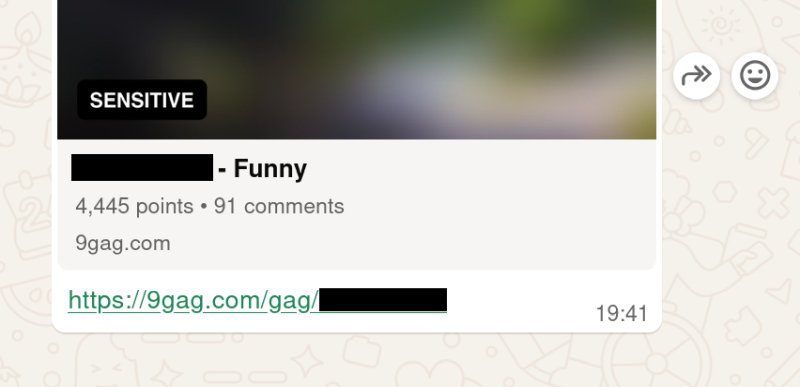
Figuring out the culprit
Before crying wolf, both of us decided to be quite diligent, and investigate what gives:
- Both of us are running Android phones. When this happened, I was using the Web version of the app through the browser.
- My friend had link previews enabled, I did not. Once my friend turned off link previews, there were no more thumbnails generated, and consequently, no labeling. But that does not tell me anything about the actual link scanning and/or categorization done by whatever tool on the sender's side. Also, in WhatsApp, the phone app and the Web version both have their own toggles for link previews, and you need to set them separately.
- We witnessed the labeling only for links shared by my friend while he had link previews turned on. We did not witness it in the opposite direction, i.e., me as the sender and my friend as the recipient. A possible reason, other than WhatsApp, is that I do not allow automatic system updates of any kind, including Google services and related components, so my device hasn't been "blessed" with the morality purification algorithms. Yet.
- The labeling seems to be done by AI, and it seems to be fickle. Stuff we "expected" to be labeled as sensitive, so to speak, wasn't always, and vice versa, totally silly things were blurred and marked. We tested about ten random memes (all from 9gag, mind), and the only thing in common was that, most likely, WhatsApp was doing something, based on some criteria (more on this soon).
- The label does not come from 9gag, though because some of the memes - most in fact - aren't in the NSFW category.
- WhatsApp blurs the preview when the label shows up (or is added, to be more precise), it does not do so when there's no label. That would strongly imply it's WhatsApp doing things - or WhatsApp is using something on the sender's phone (in this case, my friend's) before the content is shared.
- Furthermore, as of writing, the issue does not seem to happen with other chat clients.
And that's about it. That's the data that we have. A few theories come to mind. The mild version is that WhatsApp (or something else Android-related) is scanning public links as part of its thumbnail generation process, perhaps not unlike image proxying in mail clients. Perhaps. The semi-annoying version is that WhatsApp (or whatever) is scanning, categorizing and sanitizing public links, for whatever conceivable reason. The ultra-crappy version is that this is pure nannying and morality reaching, and that I've just had a chance to see it in action. Now, whatever the reason, whatever the culprit, the meme preview thumbnails were blurred and labeled. And there are two important aspects to this phenomenon ...
Slow and steady idiot conditioning
Much like QR code scanning, much like the upcoming Android dev verification, this seems to be another cog in the big idiot conditioning experiment that is the modern world post 'rona. Get the plebs to behave nice like, cor. After all, scanning public links means the infrastructure for ... scanning is in place. If an app can decide to tell you whether a meme is "a-okay" before you upload the link and send it to your friends in a private chat, then the said app can also do the same thing with any which content. That means, it's only a matter of a switch flip before you're asked to "verify" yourself before being allowed to see certain things.
One morality for all
Now, I hate politics, so I won't go too much into the whole collective social responsibility nonsense and the upcoming verification circus. I am actually somewhat looking forward to it, to see the chaos and stupidity that will ensue, and also, going back to the peaceful 1980s-style computing, with minimal online interaction, does not sound too bad. On the contrary.
What really annoys me is that, as always, you get the Californian flavor of superior morality as the one and only model for how things should be. WhatsApp - or whoever - decides what's sensitive, what's not, based on some shitty 19th century prudishness algorithm. This means there's someone out there writing if-then clauses, or adding "weights" to AI models, so that you get served only what's "good" for your feeble mind.
In our little meme experiment, the label "sensitive" showed on things that both my friend and I consider humorous, silly, cool, as well as stupid. And let me emphasize, we're talking about a PRIVATE exchange between two adult individuals, in an end-to-end encrypted chat program, right. And we have WhatsApp there, or whatever software in the big chain of software added the label, as a dirty voyeur in the middle, doing its dirty work.
Now, if the label actually read "public link" or "meme site" or even "potentially malicious site", I might actually grudgingly accept the process, because if the app can mitigate risks for ordinary users to some extent, then okay, with a toggle on/off, this might not be a terrible idea. But the word "sensitive" implies moral and emotional connotations. It's not information. It's judgment. And GTFO with your 19th century judgment.
What's next? What if my friend sends me a Monty Python link, is that going to be "bad" humor? Disallowed content because it does not cater to people with IQ 85, because it does not keep the moron "engaged" or "profitable" to the platform?
The worst part in this entire crappy saga is that, in parallel to this little "incident", whereby humor and nudity are "sensitive", if you deep dive into the dross pool of politics and propaganda, then there are no tools to "stop" you. If you "engage" in negative, then that's good for the system, I guess. Kindly remember what I showed you in my Android SafetyCore article and the latest Samsung A54 report. It's about the "impurity" of the human body! All of the filters are focused on nudity, adult content. Never politics, never propaganda, never influencers and their pointless ideas, nope. Human skin is the enemy, woe the human skin!
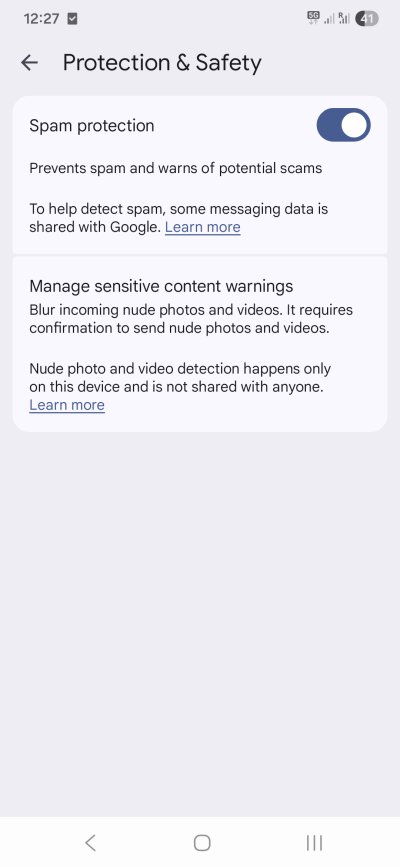
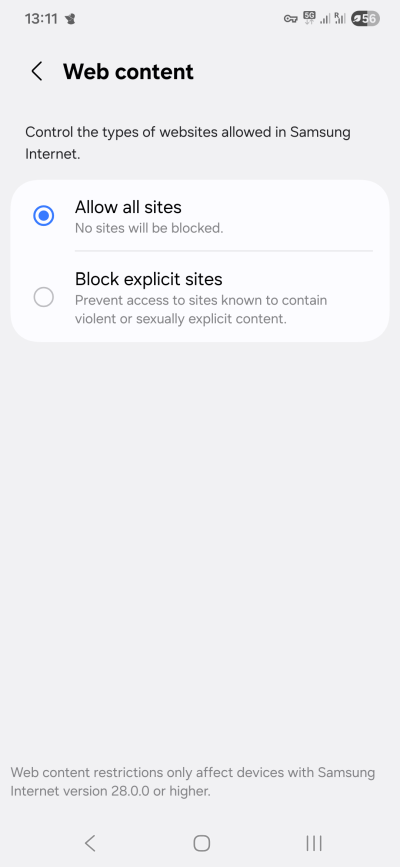
Look at those screenshots, at their text and moral judgment. Nudity and spam, nicely bunched together. Violence and sex, together. This is so the ordinary ape conflates these, so the Victorian era prudishness can be normalized as the "correct" morality. GTFO.
Conclusion
I cannot say with 100% certainty that this is all WhatsApp's fault. I want to disclaim that. But you have the screenshot there, which I cannot replicate with Telegram or Signal. I also cannot say with 100% certainty that there isn't a new (hidden) app or algorithm somewhere in the Android stack that does this job, and WhatsApp merely reflects it. But, within my limited ability to check and test things, and with all and every "safety" tool disabled in the Android stack, the end results seems to be morality filtering for public links sent via WhatsApp. That's what I can show you, and I will let you make your own conclusions as to who to blame or why, or conduct additional tests of your own.
For me, this means reducing my use of WhatsApp. As always, other people are the weakest link, friends and family, the normies, who do not care or have the ability to switch to other apps. There's also no guarantee that this crap won't spread elsewhere, alongside various "show your papers" trends, right. What I can do is simply stop sharing content. That's in my power and control. And the only party that loses will be WhatsApp and friends. If people grow mistrustful of the platform, they will be less inclined to participate. That means lower engagement, less precious data, less profit. So be it. Schadenfreude for the win. WhatsApp will no longer get to enjoy my sweet, sweet memes.
Cheers.