Updated: November 18, 2026
As a major car enthusiast and reviewer of vehicular joys, I am always happy to be able to test multiple versions of a particular model. You might say, rein in your enthusiasm, nerd, does that make such a big difference? And the answer is, yes it does. Indeed, today, I have a chance to write about the previous-generation BMW X1, with M sport cladding and a hybrid powerplant, labeled xDrive25e. About two years back, I had a chance to drive a turbodiesel edition of this car, the 18d. I loved that one quite some.
By and large, I'm rather unhappy with most modern cars, especially the post-'rona generations. They are less reliable than older models, more expensive, and they usually have compromised ergonomics with good physical buttons being replaced by cheap, pointless touch screens. But the ex-X1 is from a better era, when you still had a good blend of technologies, without going all smartphone-on-wheels. That said, I was a bit skeptical ahead of this drive, as I dislike hybrids quite some. I find them pointless, and often, they don't offer any significant ecological or economy benefits over classical ICE. Technology designed to tickle guilt glands is a no-no in my book. Cars are a utility, first and foremost. If anything, should I ever want to own a vehicle that has an electric motor, then I would actually buy a proper fully battery-powered EV. Not that I intend to do so any time soon, due to prohibitive costs, low range and extra-long charging times. Let's proceed then, shall we.
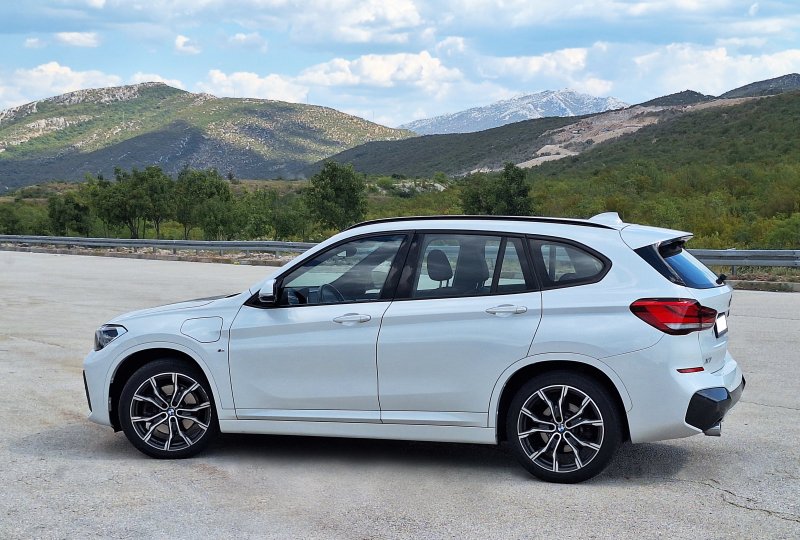
Looks, interior
The M kit is wonderful. I've always liked it, and no exception here. The sportier bumpers, a slightly more aggressive stance do make the vehicle look cooler (and supposedly faster). That said, when you actually drive a car that doesn't have too many horses, the discrepancy between your hopeful M expectations and actual results is that much greater, though. The 19-inch 225/45 wheels also look the part, but they could be even bigger.
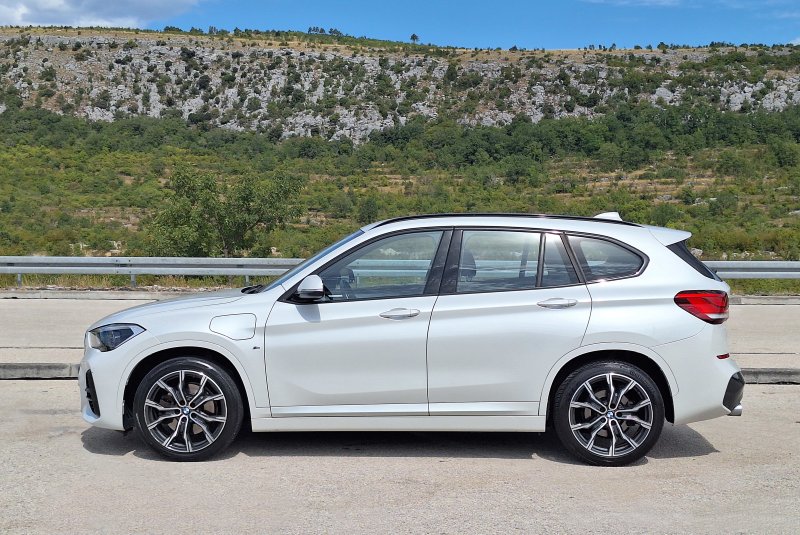
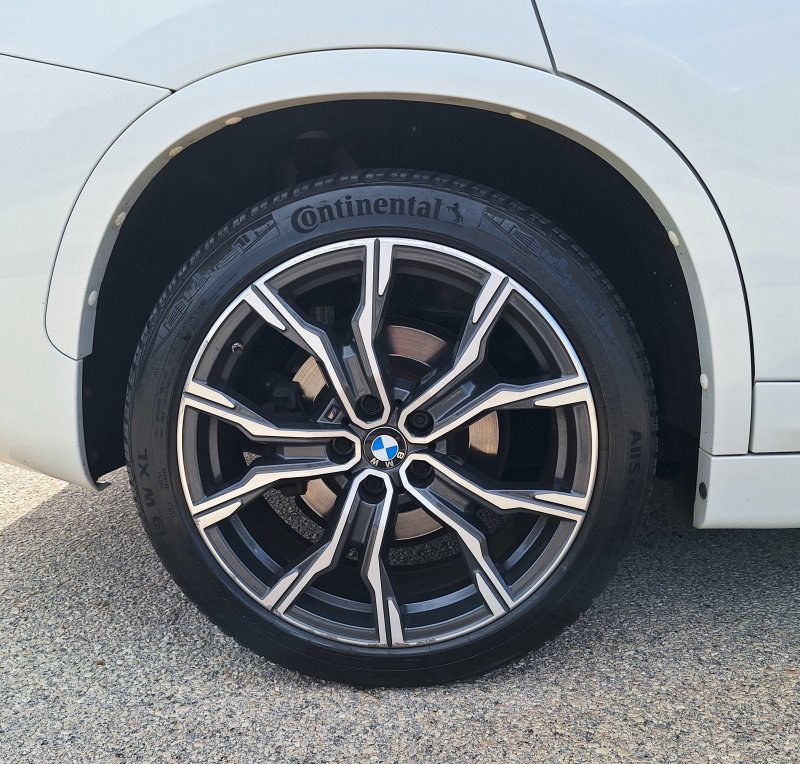
Those are 19-inch rims, and yet, the wheels still feel tiny against the bulk of the car.
On the inside, the car wasn't too richly furnished. Very similar to the sDrive model I tested, with a small no-navigation infotainment screen, but with slightly sportier seats, the nicer three-spoke M steering wheel, and some blue ambient lights. All in all, okay, but really, I think it makes no sense to offer the sport package without the full glory of wondrous and expensive accessories.
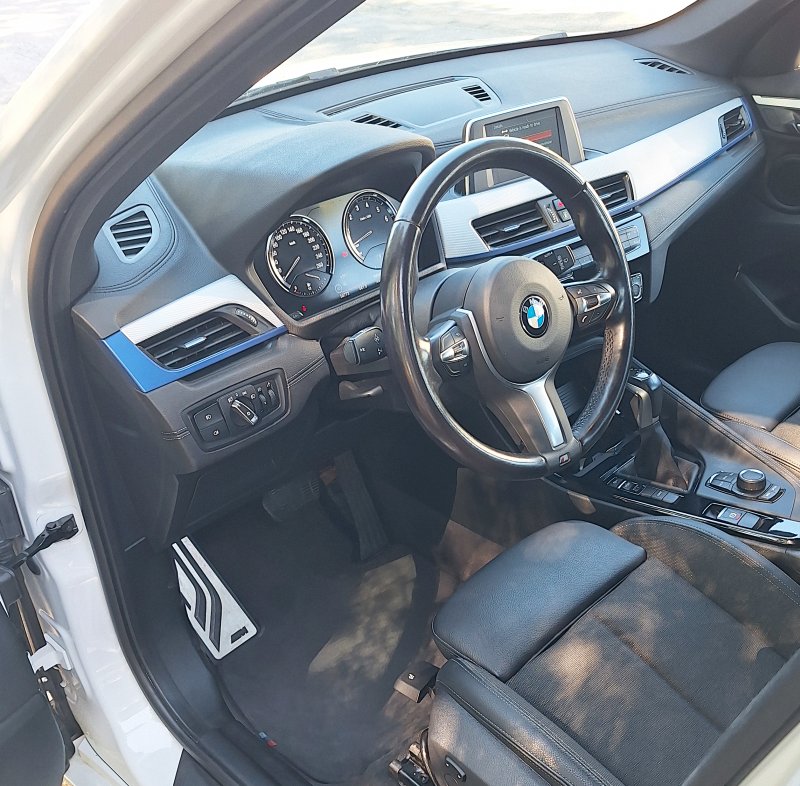
The interior is good, simple, practical. As it should be.
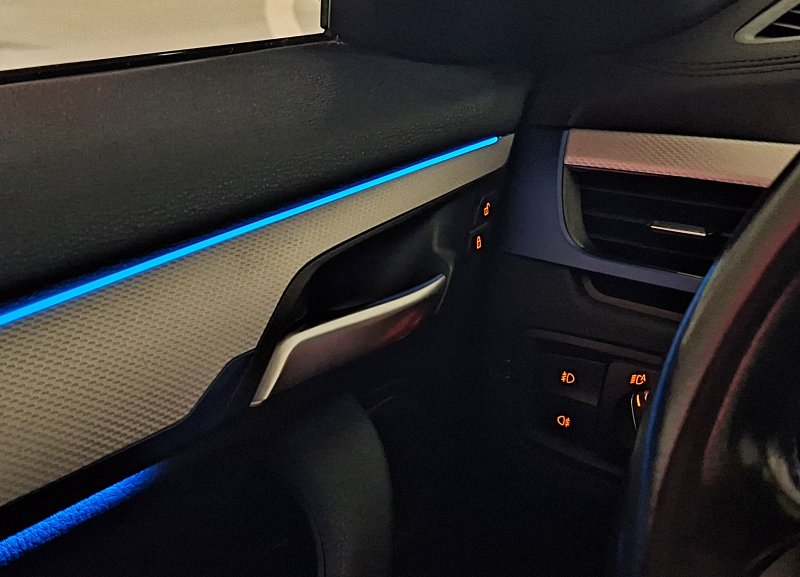
Moody blues and honeycomb detail for that extra M feel.
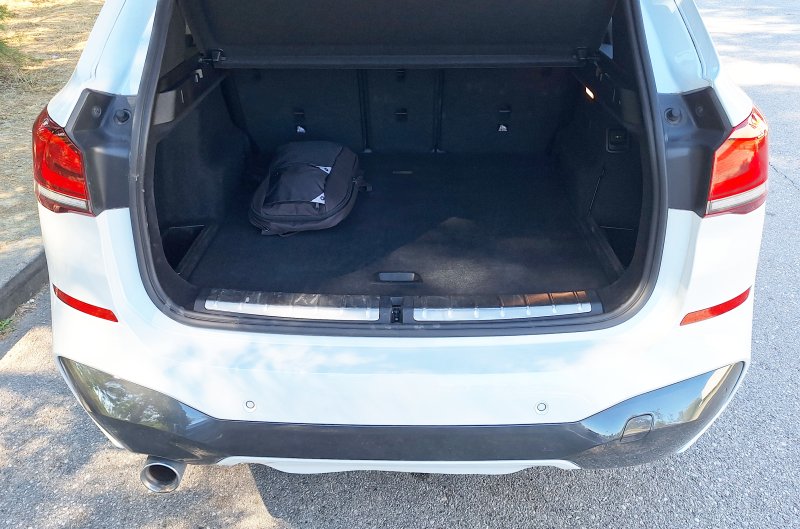
The electric component of the powertrain ought to sabotage the boot space, but I didn't feel this to be an issue. Plenty of room for stuff, hooks and bins, and the seats fold nicely, if needed.
Driving experience
With great regret, for the first time ever, I have to say I did not enjoy a BMW driving experience. And yes, it's because it's a hybrid. I've never driven a hybrid that was great fun, and this include some nifty cars, too. Nope. On paper, hybrid means the best of both worlds - ICE and electric. In reality, it's a compromise all the way through. Let me explain.
The X1 comes with a BMW's standard three-cylinder 1.5-liter petrol. In conventional models, it develops 136 HP. Here, it delivers 125 HP (I guess due to different tuning and gearing and whatnot). The electric motor is supposed to generate an additional 95 HP for a total output of 220 HP. Sounds amazing, and when you add in the torque from an electric motor, you ought to fly.
Except ...
Fed by a 10KWh battery, the motor has a range of about 50 km (in theory). That means, if you need to do any sort of serious out-of-city driving, very quickly, you end up with an underpowered petrol moving a big, heavy car made that much heavier by the inclusion of the electric motor components and battery pack.
Indeed, when I started the journey, in the city, I had plenty of nice power under my fingers. Quick, smooth and silent acceleration, good handling. But then, I ran out of electrons. Thereon, the drive was a slog. Considering the fact I did a 500km highway drive twice, that meant I spent 90% of my drive with a mere 125 HP and suboptimal automatic gearing. A slog.
Now, we're only getting started with the negatives ...
The car's handling is also compromised compared to say the diesel sDrive X1, the manner of which I've driven in the exact same conditions two years ago. The 19-inch tires generated an excessive amount of road noise, but this could also be due to their wear. Whenever I'd flip the SPORT mode on, I expected the vehicle to tighten up, to become extra sharp, nimble and fast. Nope. None of that happened. The steering wheel and the suspension did get a notch harder, but the overall driving dynamics remained sluggish.
Then, as I was pottering along, there was a beep. The car informed me I had 90 km of range left. What. So soon? I looked at the fuel gage, and the needle was pointing at one third of the tank left! One third! Normally, in ordinary cars, the fuel beep happens when you hit the red mark, which means 80 km or 5 liters. Not here, though. I guess BMW did not bother changing the instrument panel for its hybrids, so the ping happens way too soon.
I stopped and refueled. I only managed to fill 30 liters in (from one third up). You do the math. It's a tiny, tiny fuel tank unbecoming of a fairly large crossover. For that matter, you would expect this sort of fuel capacity in tiny urban cars like say Opel Adam or Fiat 500, not the X1. Ironically, sadly, stupidly, small and frugal city cars are being phased out in the name of "saving the planet", but giant SUVs and alike are perfectly fine, as long as they carry the silly (and undeserving) "green" badge. Total nonsense.
Long story short, I had to stop and refuel three times over the course of my 1,000km journey. Yup. I guess this is soft conditioning for people buying BEVs and then "recharging" their cars every 200-300 kms. So sad and stupid and pointless. In comparison, with diesels, I would always easily do this journey with a single tank.
Now, you could say, what about the electric motor? Sure, you get some "recharging" when you brake and such, but I only managed to "top up" 7 km during a particular longer descent. Elsewhere, not more than 1-2 km at best. Now, following the 7km charge, I actually stopped to rest for a bit, and then resumed my journey. And no, I didn't bother plugging the car into a charging outlet. I didn't want to waste my time with this pointless ritual.
Leaving the parking area for the highway onramp, the X1 decided to use the electric motor and its 7km charge. I expected the vehicle to accelerate fast and true. Nope. It did well until about 60-70 km/h, and after that, it was a slow, slow slog to 130 km/h. The electric motor is limited to 135 km/h. In most places, this wouldn't be an issue. The problem is, you don't arrive at this speed in a linear fashion. Ipso facto, you are struggling to gain speed as you approach the 120-130 km/h range, which means that you might merge onto a highway at a suboptimal speed. This is not only stupid, but also potentially dangerous.
The charge ran out very quickly under hard acceleration, not more than 2 km at best. I then had to let go off the gas pedal, kick it down, and finally the petrol engine engaged, and I was able to continue driving normally and safely. What a travesty.
Then, during one of the 300km stints in between the refueling stops, the car pinged. I said, okay, I am aiming for the next petrol station, about 40 km away. No other option, as it is. But then, my range went down from about 80-90 km to about 40-50 km, and the car pinged again. It decided to display a passive-aggressive lawyer-like message on the infotainment screen, which read, to the best of my memory something like:
Avoid overtaking. Drive power may be greatly reduced. Refuel for full power.
I was livid. Livid. Crappy modern-era hyperactive nonsense.
- First, a text message during a fast motorway drive is tantamount to someone using their phone. Dangerous. Stupid. And yet, when the car does it, then supposedly, that's fine. What idiocracy. How is it even possible to show so much text to the driver, while they are focusing on the road?
- Second, the message reads like a typical corporate parrot nonsense. May be greatly reduced. What? What? What does that mean? How can such a message even exist, regardless of the medium by which it is communicated to the driver? What are you trying to say?
- Third, the dashboard already pinged and showed me the remaining range. Done. The text message is unnecessary modern crap. But sure, let's show the driver extra noise, and then also load the car with sensors so the driver doesn't get "distracted" during the journey.
- Fourth, yes, I was distracted. Not by my choice. By the car itself. The car itself endangered my journey, as in those few seconds that I had to understand what was happening, from the beep to figuring out the source of the beep to sort of reading this piece of crap message, in those few important seconds, my concentration was degraded, just as it would have been if I were to use a phone while driving. Except that would be illegal, whereas having the car spam you seems fine. Absolute and total nonsense.
What about fuel consumption?
In the end, the X1 xDrive25e averaged almost 10 km per 100 km. Yup. Something like 9.7 liters/100 km to be precise. A travesty. Awful. Simply awful. As I've done this particular journey multiple times, I can easily compare to other models:
- BMW X1 sDrive18d used about 6.5 liters/100 km. That means the hybrid used roughly 50% more fuel.
- Skoda Superb 2.0 TDI used only 6.1 liters/100 km. Even better.
- VW Passat 2.0 TDI used only about 5.5 liters/100 km. Almost half the hybrid's thirst.
So, effectively, the "green" "hybrid" used 50-90% more fuel than "naughty" diesels. On top of that, the journey experience was more fun in these diesels, as they had both more power (consistently) and more torque, which I could use all the time, rather than for just a few measly minutes in the city.
Why such high consumption, you wonder? Well, as Jeremy Clarkson explained more than once in Top Gear, when you have an underpowered car, you actually work harder when you need to accelerate or overtake, which results in higher fuel burn. The X1 xDrive25e revved at 3,000 rpm while cruising at 130 km/h. This is a pretty high range, hence the bad economy.
Now, what else? The seat was quite comfy. The driving position is good. As I had no navigation available, I did use Here WeGo on my phone, and it did its job admirably, with only a tiny error or two, and overall, so much better than my experience in say the Passat, which struggled to give me precise directions in almost identical conditions a while back. And that's about it it.
Conclusion
There you go. My X1 eDrive25e review. It figures. I've never ever driven a hybrid that was nice. Never. This sort of vehicle should probably not exist. It's there to create the illusion of carbon love and such, but in reality, you have a more expensive car with a compromised drive. Sure, if you only drive around town, your range is about 10-20 km at best, you never exceed 50 km/h, and you can plug your car into a socket somewhere, then maybe, the hybrid could work for you. But then, if that's the case, why do you need a giant SUV with 220 HP for your town driving? Ah, but small cars are the devil, and need to be excised. Sure sure.
The funniest part is, I sort of had luck, since I've already driven the diesel edition, and I wasn't sure if I might get another chance to sample this particular vehicle. In that article, I emphasized the critical importance of a sane interior layout with real physical buttons and all that. As it happens, the new model is "modern", which means suboptimal ergonomics with too much touch nonsense. And apparently, BMW is going to get rid of physical buttons completely, even as its competitors are doing the exact opposite due to clear and sharp customer backlash and actual road safety statistics. Apparently, the brand wants to appeal to "younger" audiences. This is mega irony, as the average BMW driver is deep into dinosaur territory, easily well over 50 years old. And you need that sort of seniority to actually have MONEY to buy these cars. So yeah, go right ahead, boldly forward, appeal to the "younger" audiences. I'm sure they'll appreciate social media on their infotainment consoles. Oh right, they won't, as they won't be able to afford them.
Now, to summarize it, the X1 hybrid with the M kit looks the part. It's pretty and comfy. But it doesn't drive well, it's got poor autonomy, and subpar performance. This is actually an insult to what a BMW should be like. And just to emphasize it further: I've driven an M4 in Germany. A supercar with 425 HP. And it ONLY drank 11 liters per 100 km, not much more than this planet-loving hybrid. And I drove the M4 beast on the autobahn, with great gusto, in excess of 200 km/h. Let that register with you, dear readers.
So, overall 5/10. I'm disappointed and sad. But there you go.
Cheers.