Updated: May 22, 2026
This is going to be a short article. A short happy article. Back in 2015, I purchased one G50 machine, a mid-level laptop, intended purely for (Linux) distro testing purposes. Since, I've used in extensively, with probably at least 100 distros tried. At one point, I even had an eight-boot setup configured on the system. Jolly jolly times. All these adventures are meticulously detailed in my Linux section, so feel free to roam and explore at your leisure.
At some point, the inevitable software bloat made the boot times excessively slow. Three minutes and counting. But then, I decided to remove the crusty and rather snail-paced HDD that came with the box and slot in its place a speedy SSD, and ever since, the laptop has kept going on, most loyally. In this article, I want to briefly cover the last couple of years, the fun and games one can have with old hardware, plus a cautious message for the future. Let's.
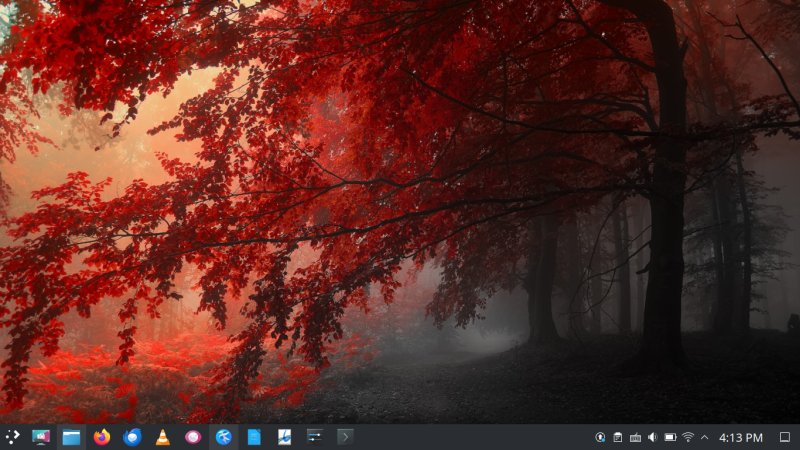
Full HD media, virtualization, you name it
This "lowly" box comes with a 2-core, 4-thread i3 processor from 2015. Eleven years. Integrated graphics. A rather okayish 8 GM of RAM, one could say. Despite the specs that seem outdated today, the laptop can still play full HD content without any problem, be it local media in VLC or streaming in Firefox. Things are quite sprightly.
But I decided to make it even more interesting. I set up VirtualBox 7.2 in the resident Kubuntu 24.04, and then, I spun up a namesake virtual machine, giving it half the system's CPU and memory resources. And still, things work fine. I turned compositing off, but even with it active, the laptop is no slouch. Hint: compositing is one of them things that you CAN enable or disable in the X11 desktop, not so in Wayland. Funnily enough, my host uses the kernel 6.8, whereas the guest has its HWE stack, which means the brand new and dandy version 6.17. Lovely jubbly. And not only does it not limp, everything works quite all right. Reasonably fast!
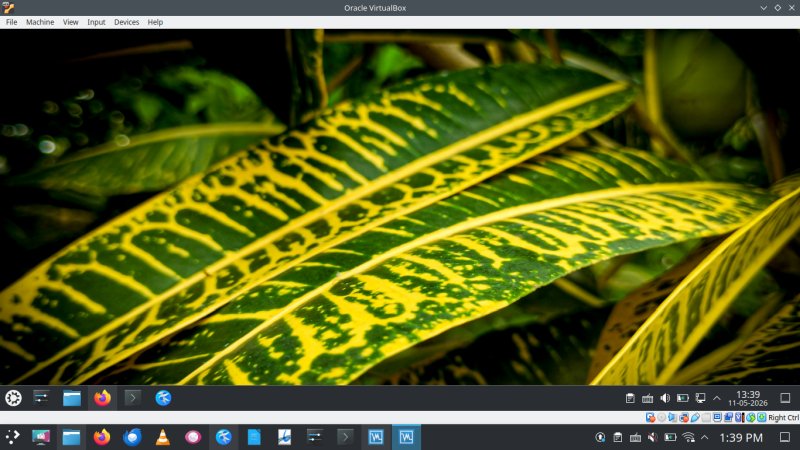
Speaking of Kubuntu 26.04, I tried it as the guest operating system, and I didn't get far. I guess there was some problem with the virtualization 3D drivers and Wayland. I also remembered that Kubuntu's installation slides mentioned the ability to use the distro on 7-8-year-old hardware, as if that's an achievement. Probably has to do with whatever arbitrary limitations have been set for old Nvidia drivers and Wayland, because legacy stuff is boring, innit.
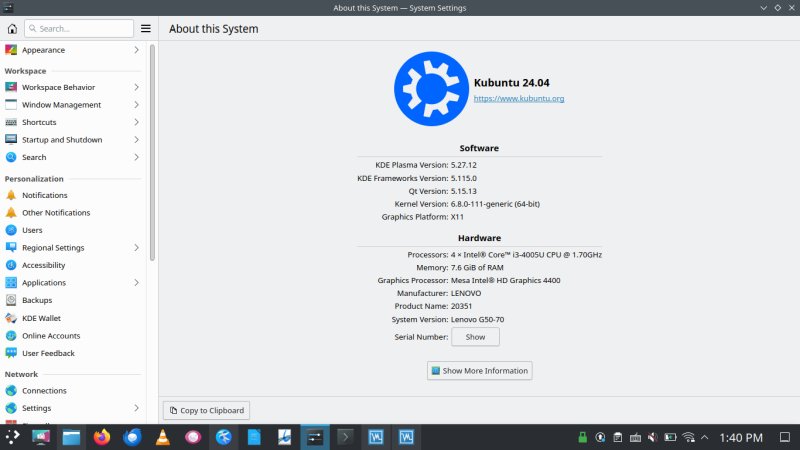
But yeah, the machine works superbly. The boot times are around 18-ish seconds total, which ain't bad considering I get similar results on a system four years younger, with a Ryzen 5 processor and NVMe. See my Kubuntu 26.04 review for that, please. And remember, the laptop has a fully removable battery, which you can easily replace, and there's a DVD tray, too. Still works.
Conclusion
Desktop computing peaked - or plateaued - around 2012 or so, even since Intel released and refined its "eye" generation of processors. At that time, it was clearly evident that any future improvements in hardware would not render revolutionary changes like in the decades before. This also meant that you didn't need to rush replacing your systems so quickly anymore, and if you lucked upon a sturdy reliable machine, you were in for a treat. My Lenovo G50 is a good example. Sure, its original operating system was useless, it was riddled with nonsense vendor crapware and alike, and I had lots of issues with Linux early on. But as a piece of kit, as hardware, it endured and proved itself many times over.
When I look at the current compute landscape, it is so obvious that big companies want the end user to keep arbitrarily refreshing their gear all the time, and if they won't do it voluntarily, then there will be software mandates and limits that will force people to buy and use newest and latest models. If you're confused what I'm talking about, it's this whole QR codes, ID verifications, passkeys, and similar nonsense. My Lenovo G50 is a relic from a different, better time. A piece of metal and plastic built to last, and last it does. For its relatively humble price, it has more than justified its value. I hope it will serve me for years to come. On a happy, maybe even nostalgic note, Dedo bids you farewell.
Cheers.