Updated: July 8, 2026
For me, the last couple of months in the open-source software world have been rather wild. Well, I guess, for everyone, too. Don't hate me for saying this, but have you seen the Netflix show Stranger Things? Linux seems to be the underside reality, because quite often, when I seek hope and joy, I find despondence instead. Why, you ask, I would assert such an asinine and defeatist claim? Nothing like a good rant to justify myself, then.
In this article, I would like to bring up a few things, which I've mostly picked up from various articles here and there recently, as I shall soon elaborate. The usual and not-so-usual comings and goings in the Linux desktop space, with lots of missed opportunities. Having invested two decades plus in this domain, I cannot just sit idly and watch wonderful technology get woefully wasted on fads, hype and total misunderstanding of usability. Let me then share, and you feel free to send me angry emails. Or ignore me. The usual deal.

Not as glamorous as the Red Arrows upside down.
Note: Image taken from Wikimedia, licensed under OGL 1.0, Photo: Cpl Andy Benson RAF/MOD.

KDE work, the good and the bad
I will start by saying the following: Whatever you think of KDE, this community at least openly shares its work, and frequently provides updates on their projects, for better or worse. This is a brave thing to do, especially in the Linux space, as people will more than enthusiastically express their disapproval of even the tiniest thing. KDE also tends to listen to their users and tries to interpret the feedback (alas, often wrongly), it tries to make its tooling more useful to the wider audience, and thanks to the Steam & KDE cooperation, there's a real chance of seeing something nice come unto this cruel world.
But then, occasionally, I read a blog or two, usually by KDE's Nate, and me eyebrows get somewhat squiggly with confusion. More recently, I came across two reports that simply made less sense to me. One is the supposed success of Wayland, with 95% of users running it as default in the latest version of KDE. The second is the decision to include and remove certain software in KDE Linux, KDE's take on atomic distros. Let us debate this, shall we. And before we move on, may I remind you that I use Plasma as my desktop in all my Linux production systems, all Kubuntu to be more precise, and that it is quite definitely the best desktop around, and that I'm very happy with the rising trajectory of KDE in the past couple of years. But never a fanboy, I am not blind to nor supportive of potential pitfalls and problems in open source, and I dearly want to help the wider community avoid them, if possible.
Wayland
Let's start with the Wayland "statistics", and why they are meaningless:
- Originally, KDE planned to support X11 until Plasma 7.0. This was an arbitrary cutoff date, not based on any achievements in the Wayland stack.
- Then, this was arbitrarily changed to Plasma 6.8. Simultaneously, Kubuntu decided to drop X11 in the 26.04 LTS as the default option, and even remove the X11 desktop session, even though Ubuntu does include the necessary packages in its repos (and will support them for 10 years), and despite the fact Wayland still does not have functional parity with the "legacy" framework.
- Wayland gets pushed more and more aggressively, even when it's not warranted. That said, the framework is improving, and I have reported this, twice, both in my Plasma 6.5 review and in my Kubuntu 26.04 review. Yes, Wayland is getting better. Even I say that. But it is still not good enough.
- Now, we have "data" that shows Wayland supposedly being so nice the majority of people uses it.
Okay, cool. So far so good. But what does this mean in practice?
Now, here's my take on the things. First, you can check my Linux section and read the articles from the past year or two to get a better sense of my approach. In particular, you may want to read a handful of longer, more philosophical pieces like the Old problems new tools one, perhaps my product philosophy rant, and then some. This will give you a solid understanding of how I perceive software, and what I think needs to be done to gain meaningful traction in the Linux desktop space.
Second, let's talk numbers. Ubuntu is the most popular Linux desktop distro, and it has more usage than pretty much all other Linux desktop distros combined. Within the Ubuntu family, Ubuntu itself is also an order of magnitude more popular than any other flavor. If you are wondering where my data comes from, feel free to do your own search and data analyses independently, including but not limited to website statistics, search trends, reports by distro teams where available, store statistics, forum statistics, and then some. I am positive you will not find me in error. But if you're looking for an opportunity to ignore me, here's your exit. Call me delusional, and click away.
The Linux distro spread means that KDE-based distros, SteamOS excluded, will account for a somewhat smaller percentage of the overall Linux desktop usage. Unfortunately so, because it should be the default Ubuntu desktop, and it's my dream for this to come true one day.
Within the KDE space, you have Kubuntu, KDE neon, plus some Arch, Fedora and friends. But much in the same manner as with across-the-distro distribution [sic], Kubuntu holds the lion's share of the KDE userbase, and then, within this pool, the LTS dominate. Effectively, 24.04, with some 22.04 and 26.04 in the mix. Everything else accounts for a small pool of systems.
All Kubuntu LTS until the last one shipped or ship with the X11 session by default. This means, all things being equal, that most people definitely use X11 in KDE. Now, what the KDE's data shows is that, among the small pool of non-LTS users, among those who run the latest Plasma version, and among those who chose to send their telemetry data to KDE, 95% of them were using Wayland. If the pool is a mere 100 users, there's little to celebrate. But if the pool is in the millions, good, we're getting somewhere. Even so, 5% of people not being able or wanting to use a certain technology is no small number. If we go by that, Linux shouldn't matter, as its overall desktop usage share is below this figure, and all the smaller browsers should die, too. Nope.
Also, accessibility. Less than 5% of people suffer from permanent disabilities. Yet, they deserve every bit of fair access to technology, even if their numbers are minuscule. Thus, even if 99% of people use any one solution, that does not mean the remaining 1% or whatever can be dismissed. If anything, the fact 5% of people still use X11 when they "shouldn't" is actually an alarming sign that things aren't all a-okay.
Now, how big is this pool of users really? Here's my estimate, this one NOT based on any concrete data. Pure speculation, so again, a graceful exit point for those who disprove of my article. An interesting intellectual exercise for the rest.
If the Linux desktop has a 5% market share, and this is being mega generous, we're talking a total pool of roughly 100 million desktop devices, let's say. Of those, Plasma accounts for probably 10M devices or so. Of those, I would hazard that at least 9M devices belong to the older 5.X family (and LTS). This leaves us with approximately 1M devices, spread across several branches of the latest Plasma family (6.X), probably the last two or three releases.
Now, the question is, among these users, how many users actually enable telemetry?
To answer this, I will reference the Gnome data from 2023. This article mentions about 2,500 deliberate opt-in responses from users in a survey. How big is the pool of Gnome users? Impossible to say, but since this reporting isn't limited to any one distro, we could assume it was available across all the different flavors of Gnome, across all the different distros that offer this desktop. And the entire response pool was just 2,500 answers.
Thus, if we assume even as few as 1 million people were somehow exposed to the survey, this is still 0.25% of the total userbase*. And please note, I assumed that only 1 million out of possible 90M Gnome desktop users (based on earlier Linux numbers calculations) saw this survey. Therefore, the actual response rate is two orders of magnitude lower, probably in the range of 0.00025%. P.S. The article has many other interesting tidbits, including the over-representation by certain distros (and their users) and such. A wealth of data for those who truly care about statistics, and please remember, the art of statistics is counterintuitive. Back to the topic, shall we.
This means that among the estimated 1M Plasma 6.X users, only 25-2,500 provided their info. And these are the diehard nerds who care, and therefore, do not represent the general population in any way, as Linux itself does not represent the general population in any way.
We can now play with possible numbers any which way we like:
- The Linux desktop share is 1-5%, so 20-100M desktop devices, more or less.
- The Plasma desktop share is anywhere between 10-50%, so 2-50M Plasma systems out there. The higher values are most likely a serious overestimate.
- The 6.X branch represents 10% of the total installation pool above, 200K to 5M devices. The higher values are most likely a serious overestimate.
- The telemetry rate is 0.00025-0.025%. The latter is the most optimistic, extremely overestimated case, so we have a total of between 50 (not thousand) and 125K responses.
Now, if I'm trying to be more realistic, the desktop share is 1%, Plasma takes roughly 10% of it, and Plasma 6 takes 10% of that, so we have 1% of 1% for Plasma 6, and the opt-in response rate comes with several decimal zeros. But even if I'm being extremely generous and assume 1% of people responded, we still have 1% of 1% of 1%. Not representative. At all.
Now, let's assume I'm wrong. Totally wrong. Like totally totally totally wrong.
Let's assume 100% of Plasma 6.X users are happy with Wayland.
Why report it? The decision to move to Wayland was made BEFORE any 6.X branch was truly mature, the dates for the cutoff were set arbitrarily (twice). The decision for Wayland was not based on any data. It was an administrative decision. Pragmatic or not, good or bad, it does not matter. It was decided.
There's no need to retro-justify it.
In a way, this reminds of me of the "statistics" around electric cars. Nowadays, small petrol models are being retired, electric versions are introduced, with no ICE alternative, and most cars come with some form of hybrid, including the so-called "mild hybrid" nonsense. Then, the statistics show how more and more people are buying these vehicles (supposedly voluntarily). Well, sure, Sherlock, if they have no other option, yes, the sales of electric variants will be on the rise. Does this mean anything in practice? No. Marketing nonsense? Sure.
If Wayland is the only option, no need to rub salt into the wounds of people keen on productivity and ergonomics. Just let it be. The Linux world embraced mediocrity as the way forward, so be it. Don't try to make it into some majestic success story when it is not, nor will it ever be.
Let me put it the other way around: What if the share of X11 users on 6.X or whatnot that sent in their telemetry was say 40-50%? Would that warrant a rethink of the Wayland story, or the postponement of its implementation?
Of course not.
Remember, the dates were decided before any data existed!
The majority of Linux systems use X11. Today. With Ubuntu 26.04 only now released (two months), the bulk is set on X11 in the 22.04 and 24.04 LTS editions. The same applies to most other desktops and distros and whatnot. You can do any sort of mathematics you like, you won't get a different answer.
The Wayland decision has nothing to do with percentages or pluralism, because it that was the case, Wayland would not be. It took a FORCED decision by Gnome and then KDE to "kill" X11 and remove the session login option to show "success". Yes. And even with this forced choice, where one manually needs to install the second session, Plasma's latest release still has at least 5% users on the legacy desktop, among the reported numbers, which are most likely done by those closely invested in the platform. There's no democracy here.
In some ways, Wayland is like the perfect government tender. The "winner" has been decided in advance, there are no hard criteria for success, and it's been 15+ years since the project started, and it still does not best its legacy rival. There are some dozen implementations of Wayland, with KDE's being the most mature and feature-rich one. I mean, kudos to KDE for trying to make the impossible slightly less improbable, but the retroactive justification is totally unnecessary. Wayland was declared the "modern" replacement many moons ago. It's the FOSS corporate equivalent of the typical office mediocrity game.
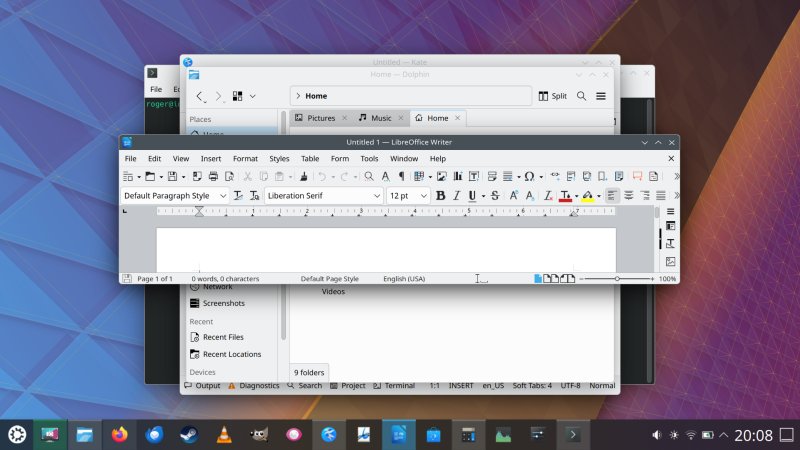
Session restore in Wayland, as of Kubuntu 26.04. All of the windows are bunched in the center. Meanwhile, I had perfect or almost perfect session restore in Kubuntu 18.04, with X11, of course. So, give or take eight years, and what?
At the same time, I will also note this: In Kubuntu 26.04, the X11 session works just fine, besides, it is the default for several other flavors of Ubuntu. That means, at the bare minimum, you will have good desktop usability until 2031, perhaps 2036, with the extended PRO updates. By then, KDE should improve Wayland significantly enough that it will be truly good for everyday use. I hope.
And all this said, I will happily use Wayland if and when it becomes capable enough. If and when. There's no zeal on my side, no devotion to technology. Just usability. Give me good tech, and I won't complain. But don't give me average tech and call it gold. That won't do.
* Final note on this, I know what you're going to say: Dedo, Gnome mentioned that their sample pool was small, with the survey mostly communicated in the close circles of the community! You know, that only makes my case even stronger. Assuming only a few thousand people saw the questions and responded, which would imply a very high response rate, that means the data comes ONLY from hardcore fans, who are invested in the system and who do not represent the wider audience. That would also apply to the KDE Wayland story.
NTFS, fuse2
Another wee announcement in KDE's monthly rollup - the inclusion of the new NTFS kernel driver, and the removal of the userspace ntfs-3g utility. If you've read my NTFS saga recently, you can imagine my skepticism and perhaps even wonder. The new kernel driver has not proven itself yet. The old one has proven itself buggy, and I lost data with it. The userspace utility is slow but reliable. And tiny. Why remove it? I find it paradoxical that atomic distros ship with these huge app containers, the updates are massive, but a few measly KB of filesystem support? Nah.
But then, there's also the removal of fuse2. The justification is that it's insecure (mkay, local attack surface), and that developers of software that rely on this library (mostly old AppImages) should fix their stuff. And this is exactly the sort of upside down logic in Linux!
The operating system should enable its users - not restrict them. Not providing support for "old" stuff is the opposite of good experience. After all, pretty much every computer game released in the 1990s or early 2000s is considered old or obsolete or abandoned today, from development perspective. That does not make them useless. On the contrary, they are a valuable piece of history, and we must cherish them, the same way we cherish art in museums, and we don't expect artists to "update" their work. Plus, many of those games still have large, active fanbases. There's no "continuous development" story here. A done product is done.
The best example for the good experience approach is Steam. They are constantly expanding their catalog, they care about old titles, they forever support old games, and they even use Proton, which enables Linux folks to enjoy Windows games, beyond any intended use. That's great. As it happens, Windows also provides decent backward compatibility for software. HOW IT SHOULD BE.
So, no developers should not update their old stuff. It is what it is. The user can choose to run old stuff or not, and the operating system, if designed well, should provided space for this to happen. Alas, backward compatibility barely exists in Linux, and it's getting worse, for the most part. If you think about arbitrary decision to cull certain drivers or software frameworks, the reasoning is purely based on development requirements, never on the end-user requirements.
The security angle for fuse2 is also funny. I will soon explain why.
Flatpak goes systemd
There's a constant battle between Flatpak and snap, of course. Which is better? The nerds have their wars. For years, if anything, the Flatpak community could claim one neat advantage - the framework was not based on systemd, which, in my book, is always a plus. The less systemd, the better. Alas, no more. Maybe.
From now on, yet another piece of the ecosystem mighty get devoured into the ugly, messy blob that's systemd, against all the fine principles of simplicity that embody - or should embody - UNIX-like systems. Complexity is the new simplicity, it seems. Coincidentally, the linked article also talks about Linux popularity and usage, and it also mentions Ubuntu being more popular than all the other distros combined.
Going systemd would be extremely bad. It's like the ntfs-3g and fuse2 removal. Reducing compatibility and user support even further. See how all these stories tie in nicely together! Now, there's an extra angle related to Flatpaks, though. The security angle. To wit.
The security circus
If you've been following the IT news in the past month or so, security, so hot right now. Thousands upon thousands of projects are getting hacked, malwarized, taken over, subverted, and ruined in an embarrassing tsunami of bloopers and problems and hacking. I won't go too much into details, but I will focus on the Linux desktop side of things.
As we're witnessing fake software being pushed as revisions to totally legitimate software, as credentials get stolen and the issues only get bigger and more widespread, in parallel, we also have the blithe sweet ignorance of Linux software delivery, contrary to every piece of evidence from the past several weeks, as I also recently showed you in my not so happy Fedora 44 review. You casually open the distro's software management GUI called (Gnome) Software, you search for popular stuff, and instead of official applications, you get third-party-wrapped unofficial options. Yup.
Now, if these sources offered only the unverified, third-party stuff, one could sort of say, it's better than nothing. But no. It's so much worse. The GUI ignores the official software, provided by Fedora, and it shows only the unverified software, hosted on a third-party server. So, it's a double whammy. Ignore legit, show something else.
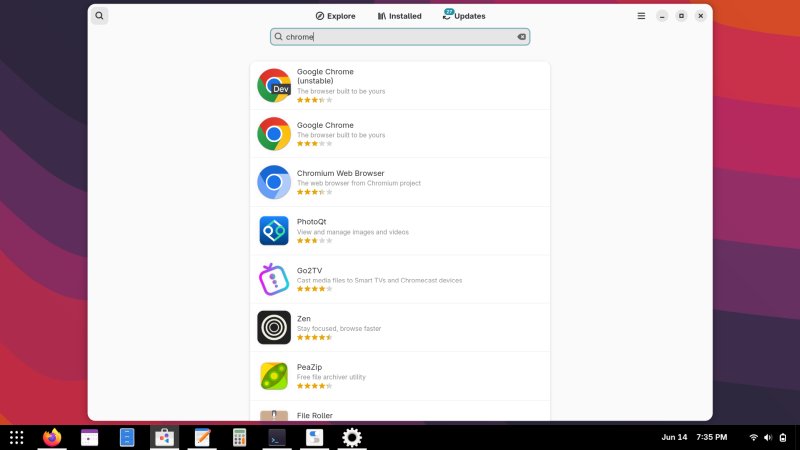
The results shown above are NOT official Google Chrome.
What makes things so much worse is that this is not a new problem. But it is a self-inflicted problem. There's a couple of "new" trends in the Linux desktop world. Once again, we have the imitation of Google and Apple, without any real benefits.
In a nutshell, the Linux world is pushing toward new packaging methods, essentially Flatpak and snaps. To make things even juicier, the community likes to see is as snap = (evil) Ubuntu, whereby supposedly, Flatpak is the "open" savior (the systemd news might change this perspective). Hence, you will see non-Ubuntu communities promote Flatpak as the counterpoint to Ubuntu's work, even when the actual results are counterproductive, like what we see above. The insistence on showing (only) Flatpaks from FlatHub in (Gnome) Software results in the paradoxical security situation, while Fedora's inclusion of Google's RPM repository for Chrome is ignored. From a security perspective, this is awful, because Chrome isn't just any random tiny program.
To make things even worse and tragic, KDE is now embroiled in the same problem. This brings me to the second fad. Atomic distros. Everyone things that by making Chromebook-like stuff, Linux will suddenly see a resurgence of popularity, which is both sad and completely misses the real usability issues in Linux. Why isn't Linux so widely used? Well, start with backward compatibility for one! Why would anyone want to use systems that don't let you run old software, for instance.
Atomic distros. This means, read-only system plus Flatpaks. The community's take on the matter. But the problem is, there are only so many verified Flatpaks. If these are excluded from the equation, the software offering looks meager and poor. And that's a hard sell, a store with say 100 applications. Although technically it's better to have a TRUSTED store with a small array of good programs than a huge UNTRUSTED store full of crap and malware, the notion of quality and growth and similar corpo-like nonsense seems to pervade the general spirit.
And this is why the problem is still here, even though I brought it up many many times before. I mentioned the problem in my Zorin review. There, I showcased the same unverified software fiasco with Steam rather than Chrome. But it's the same principle. I mentioned this in openSUSE Tumbleweed. Undeterred, I mentioned this in my Fedora Kinoite review, my Fedora 42 review. Time and time again, I brought this horrible security loophole, but apparently, either no one cares, or if they do, they ignore the problem. Since, the software landscape had only gotten worse. Remember, thousands upon thousands upon thousands of projects had been hijacked in only the last month. We're talking colossal issues. Even Red Hat had some repos compromised, and Fedora noted problems with some AI agent trying suspicious commits to the Anaconda installer, leading to the reversal of commits. And in this reality, we have software tools offering third-party packages like it's the good ole university days in the early 90s.
The number of security issues is so huge, it's hard to keep up. Even when I posted my Fedora 44 review, my AUR packages story link was already out of date, by mere hours, with the number of compromised packages growing from about 400 to about 1,500. And now, here's the funniest thing. The wider Linux community likes to foulmouth Canonical and Ubuntu for being the "bad" guys of FOSS. It's almost a sport if not a fervent hobby. But at the same time:
- Ubuntu was one of the few major distros that did not commit the XZ malware.
- For all its problems, the Snap Store at least uses name reservation for major, popular projects so a random third-party cannot upload a "lookalike" snap with the official name. It's not a perfect method, but it's better than nothing.
- The aforementioned Snap Store is owned by a company. So if things go wrong, there's an actual legal entity to blame. You don't get such guarantees with community stores, for better or worse. I know, I know. Android Developer Verification is a good example why you don't want companies being the sole gatekeeper of software, but wild anarchy isn't the answer to that.
- Ubuntu offers you 10 years of updates for all their LTS for free, with the first five being the standard, and the extra five as part of the PRO setup, which is available to home users without cost or any strings attached. This is also Canonical doing the patching, not volunteers or community. The PRO offering also means live kernel patching, and more goodies besides. Proper system certification and all that. Proper security stuff.
Am I shilling for Ubuntu? Not really. I'm still sad and angry that Canonical retired Unity and chose Gnome instead, which to this day is inferior to the old desktop and probably the main reason why the Linux desktop hasn't really made any progress in the past decade. But the infrastructure is solid, and if I need to use Linux for serious activities, then I want the code to come from Ubuntu's archives. I am definitely not going to be using random happy-go-lucky software bundled with hope, no matter what format.
For those of you struggling to keep up, yes, I do use Flatpak, too, here and there, when needed. Verified packages only, of course, and even then, with great caution and reservation. I have no real interest in anything by random contributors, no matter how benevolent or benign, because in principle, that's no different than going to any which site, downloading any which program, and hoping for the best.
Conclusion
What do you make of this article, eh? Well, as always, my good intentions will be misconstrued by many. What makes me sad is that at almost every opportunity that the Linux desktop has had to rise, there was always subconscious sabotage. There were so many great chances, like the death of Windows 7 or the current boogaloo with Windows 10/11. Have those been utilized to maximize the presence of Linux in mainstream use? Of course not. Mainstream is treated with disdain. In some ways, yes, the community is right, mainstream is poison, and it will include lots of "show your papers" rituals and similar nonsense. But then again, the Linux folks also bemoan the lack of recognition and inclusion in software discussions, which stem from low usage.
And we circle back to what I wrote in 2009, and how to make Linux more successful. Steam is doing their part. But the rest of the ecosystem still struggles from what can be best described as "developed-focused" work. When will the Linux community realize that it's not about developers. They are a tiny part of the population, and their brain patterns are orthogonal to how people utilize their machines. And we don't need to look at simians swiping left and right for inspiration. Even "ordinary" educated non-developers face massive challenges using their (favorite) operating system, because it is designed for people who design it in the first place, a bittersweet recursive paradox.
The examples of tiny utilities being deprecated (before viable alternatives are proven for use), the security nonsense, all these point to a rather naive disconnect from the harsh, ugly reality around us. In some ways, I envy the Linux folks. I would like to have the same approach, to innocently believe the world is better and nicer than it is. But then, I also need to be pragmatic, and every time I power my Linux systems, I wonder what will happen in a year or two. There's no safety anchor. I can't rely on a stable future. The only supposedly redeeming thing is that EVERYONE else is now also doing their best ruining stability and consistency as usability factors. But that just means less fun overall. It's a lose-lose situation.
I wish the Linux desktop makes it big. I want people to say Ubuntu or LibreOffice or VLC or Firefox or similar when they think software. Maybe if this ever happens, maybe the AI-fest morality brainwash around us will cease. But then, in a classic one-two, the Linux hobbles itself yet again, for the thousandth time. I know you think I'm a cynic, but I'm looking far down the road.
You can't have gazillions of clueless Windows people switching over when the distros are focused on reducing backward compatibility as much as possible. It can't happen when the Linux software store are just as bad as the big corpo store fronts. No one needs a "free" imitation of the pointless consumerism when they have the "real" deal. If I wanted average, I can just use the mainstream blobs of Dystopia. And herein lies the tragedy. Yes, to succeed, Linux needs to become more accessible. Imitating Google or Apple is hardly the way to achieve that. If you don't understand this last sentence, it's okay. I've been writing about this for twenty years, I can repeat myself a few more times. Take care.
Cheers.